Formula One engine compression ratio issue is "close to fair but still gray area," says Yasuaki Asaki. "Honda must read the rivals' moves and schemes."
The 2026 F1 season will be a year of major transformation. The car regulations will undergo a complete overhaul, with significant changes to the chassis, power unit (PU), and tyres. Within this context, the first half of this season is said to be heavily influenced by the PU.
This season sees the complex Motor Generator Unit-Heat (MGU-H) abolished. In its place, the output of the Motor Generator Unit-Kinetic (MGU-K) electric motor will be significantly increased from the previous 120 kilowatts to approximately three times that, reaching 350 kilowatts. Also, engines are now mandated to use 100% sustainable, carbon-neutral fuel.
With new manufacturers like Red Bull Powertrains (partnering with Ford) entering the fray, early-season performance differences in PUs are expected. What are the key points for PU development this season? Regarding the highly discussed "engine compression ratio issue," former Honda engineer Yasuaki Asaki provided insight.
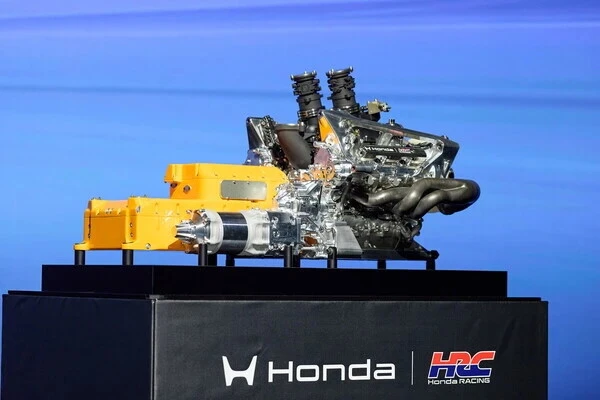 Honda's new power unit fitted to Aston Martin / photo by Shogo Murakami
【 Grey area close to fair where violations can not be confirmed】
We don't know the exact details of what Mercedes and Red Bull are actually doing in their PU development, as they face suspicion of exploiting loopholes in the rules regarding internal combustion engine (ICE) compression ratios.
However, I suspect Mercedes engineers had some idea that lowering the compression ratio to the new regulation limit of 16:1 could provide an advantage, whereas the previous 18:1 limit offered no edge over rivals. That's why they likely pushed for the regulation change to reduce compression ratios.
That idea probably spread as Mercedes personnel moved to Red Bull Powertrains, which manufactures Red Bull's PUs. While Red Bull partnered with Ford this year to compete with a PU they developed and manufactured themselves, the team's internal combustion engine was developed in-house, including former Mercedes staff. It's easy to imagine the idea leaking through these connections.
F1 developments exploiting rule loopholes are not new. For example, in 2019, some suspected Ferrari of circumventing PU fuel-flow regulations--clear misconduct then. The current discussion of the compression ratio, however, stands apart.
I believe this case is closer to fair play than a grey area. Realistically, compression ratio can only be measured at low temperatures (ambient temperature), and regulations don't prohibit engine components from deforming due to heat. We can't definitively confirm that Mercedes or Red Bull is committing clear violations.
1 / 3